

How AI Is Transforming Invoice and Receipt Processing
For decades, invoice and receipt processing has been one of the most time-consuming and error-prone tasks in business operations. Finance teams have traditionally relied on manual data entry, spreadsheets, and basic Optical Character Recognition (OCR) tools to extract information from invoices and receipts. While these methods helped digitize documents, they often failed to deliver accuracy, scalability, or real automation.
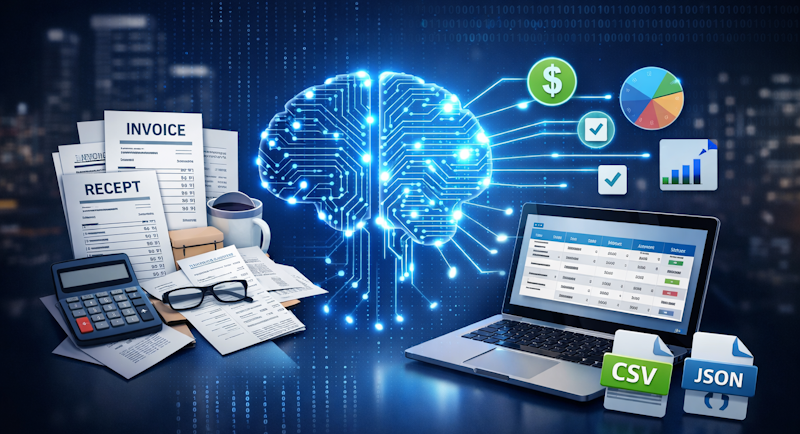
Today, artificial intelligence (AI) is fundamentally transforming how businesses handle invoices and receipts—turning static documents into structured, actionable data with minimal human intervention.
This article explores how AI is reshaping invoice and receipt processing, why it matters, and what it means for modern businesses.
The Limitations of Traditional Invoice Processing
Before AI, most invoice and receipt workflows followed a predictable pattern:
- Documents were scanned or uploaded as PDFs or images
- OCR tools converted text from images into digital characters
- Staff manually reviewed, corrected, and categorized the data
- Information was entered into accounting or ERP systems
While OCR reduced some manual effort, it came with major drawbacks:
- Low accuracy for scanned or low-quality documents
- No understanding of context (e.g., totals vs subtotals)
- Inconsistent layouts causing frequent extraction errors
- Heavy manual validation required for line items and taxes
As invoice volumes grew, these limitations became expensive and difficult to manage.
How AI Changes the Game
AI-powered invoice and receipt processing goes far beyond text recognition. Instead of simply reading characters, AI systems understand document structure, context, and meaning.
Here’s how AI is transforming the process.
1. Intelligent Data Extraction (Beyond OCR)
Modern AI models can identify and extract key invoice and receipt fields such as:
- Vendor name
- Invoice number
- Invoice date
- Line items
- Subtotals and totals
- Tax and GST/VAT
- Currency and payment terms
Unlike traditional OCR, AI understands where data belongs, not just what it says. For example, it can distinguish between:
- Subtotal vs total
- Shipping charges vs taxes
- Item prices vs discounts
This contextual understanding dramatically improves accuracy.
2. Automatic Line-Item Recognition
One of the hardest problems in invoice processing is line-item extraction. Invoices vary widely in format, making rule-based systems fragile and unreliable.
AI models trained on thousands of invoice layouts can:
- Detect tables automatically
- Extract individual line items
- Normalize quantities, unit prices, and descriptions
- Handle multi-page and bulk invoices
This allows businesses to analyze spending at a granular level without manual review.
3. Handling Poor-Quality and Scanned Documents
Many businesses still receive scanned invoices, photos of receipts, or low-resolution PDFs. AI improves extraction accuracy by:
- Enhancing image quality
- Correcting skewed or rotated scans
- Interpreting faded or partially obscured text
- Learning from corrections over time
As a result, even imperfect documents become usable sources of data.
4. Learning From Corrections Over Time
Unlike static OCR rules, AI systems learn continuously.
When users correct extracted fields—such as vendor names or tax values—the system improves future predictions. Over time, this reduces the need for manual intervention and increases consistency across documents.
This learning capability is critical for businesses that process invoices from recurring vendors.
5. Faster Processing and Lower Operational Costs
AI-driven automation dramatically reduces processing time. Tasks that once took minutes per invoice can now be completed in seconds.
Key benefits include:
- Reduced manual data entry
- Faster invoice approvals
- Lower processing costs per document
- Improved cash-flow visibility
For finance teams, this frees up time to focus on analysis, compliance, and strategic decision-making instead of data cleanup.
6. Structured Data Outputs for Modern Workflows
Another major advantage of AI-powered processing is structured output.
Instead of ending with a PDF or text file, AI systems convert invoices and receipts into structured formats such as:
- CSV
- Excel
- JSON
- Accounting-ready data
This enables seamless integration with accounting software, ERPs, reporting tools, and analytics platforms.
7. Smarter Approval and Audit Workflows
AI doesn’t just extract data—it enables smarter workflows.
Businesses can build rules and approvals based on extracted information, such as:
- Flagging invoices over a certain amount
- Detecting duplicate invoices
- Highlighting missing tax or vendor details
- Routing documents for manual review when confidence is low
This improves compliance while reducing unnecessary manual checks.
8. Real-World Business Impact
The impact of AI on invoice and receipt processing is measurable:
- Higher accuracy compared to traditional OCR
- Shorter processing cycles
- Improved audit readiness
- Better spending visibility
- Scalability without increasing headcount
As invoice volumes grow, AI allows businesses to scale operations without linear cost increases.
The Role of AI-Powered Document Processing Platforms
To implement these capabilities, businesses increasingly rely on AI-driven document processing platforms. These tools combine OCR, machine learning, validation workflows, and structured exports into a single pipeline.
Platforms like DocuNero are designed to help businesses automate invoice and receipt processing end-to-end—from upload to structured data export—without complex setup or manual intervention.
The key trend is clear: businesses are moving away from document storage toward document intelligence.
What the Future Looks Like
As AI continues to evolve, invoice and receipt processing will become even more intelligent:
- Near-zero manual review for standard invoices
- Real-time validation and anomaly detection
- Deeper analytics based on extracted data
- Tighter integration with financial systems
In the near future, invoices and receipts will no longer be treated as static documents—but as live data sources that drive business insights.
Final Thoughts
AI is fundamentally transforming invoice and receipt processing by replacing manual effort with intelligent automation. By understanding document context, learning from data, and producing structured outputs, AI enables businesses to process documents faster, more accurately, and at scale.
For organizations looking to modernize their finance operations, AI-powered document processing is no longer a nice-to-have—it’s becoming a necessity.


Comments (0)