

AI agents are becoming one of the most important developments in artificial intelligence. Unlike traditional AI systems that simply respond to a prompt, an AI agent can understand a goal, decide what needs to be done, use external tools, evaluate results and continue working until it reaches an acceptable outcome.
For example, instead of asking an AI system:
“What flights are available from Sydney to Singapore?”
an AI agent could potentially handle a broader objective such as:
“Find suitable flights from Sydney to Singapore for next weekend, compare the best options and prepare a summary.”
To complete that task, the agent may need to understand the request, create a plan, access flight information through APIs or tools, compare results and present its recommendation.
This ability to move from prompt → reasoning → action → observation → result is what makes AI agents different from conventional chatbots.
If you are completely new to the concept, start with our guide on What Are AI Agents? A Complete Beginner’s Guide before exploring the architecture in more detail.
What Is an AI Agent?
An AI agent is a software system that can observe information, reason about a goal, make decisions and perform actions with some level of autonomy.
Large language models (LLMs) such as those used in modern generative AI applications can provide the reasoning and language capabilities behind an agent. However, an AI agent usually includes much more than an LLM.
A practical AI agent may combine:
- A large language model
- Instructions and goals
- Planning and reasoning
- Short-term and long-term memory
- External tools and APIs
- Data sources
- An execution environment
- Feedback and evaluation mechanisms
- Security and permission controls
Together, these components allow the system to do more than simply generate text.
For a broader overview of agents, their capabilities and use cases, see our AI Agents in 2026: Complete Guide to Agentic AI.
How Do AI Agents Work?
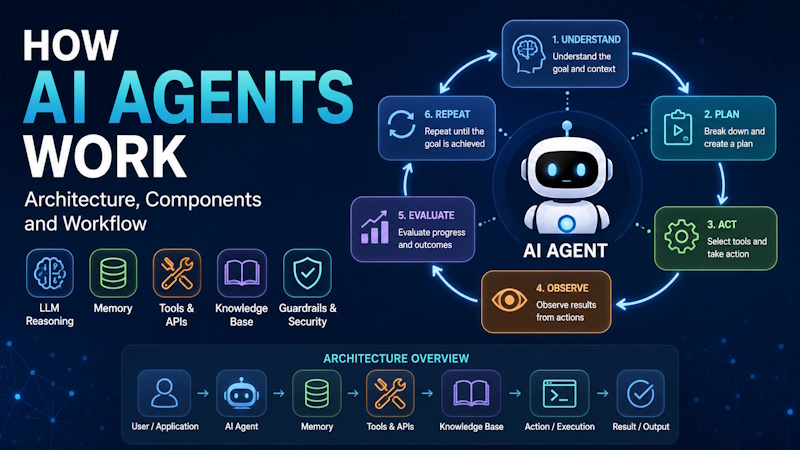
At a high level, most AI agents follow a continuous workflow:
Goal → Observe → Reason → Plan → Act → Evaluate → Repeat → Complete
Suppose a user asks an AI agent:
“Research three popular project management tools and prepare a comparison.”
The agent could process the request in several stages.
1. Understand the Goal
The first step is determining what the user actually wants.
The agent identifies important information such as:
- The objective
- Constraints
- Expected output
- Available context
- Required tools
- Completion criteria
In our example, the objective is not simply to explain project management software. The agent must research multiple products, compare them and produce a useful summary.
2. Gather Context
The agent then determines what information it already has and what additional information it needs.
Context might come from:
- The user's prompt
- Previous conversation history
- Documents
- Databases
- Application state
- APIs
- Search systems
- Agent memory
This step helps prevent the agent from making decisions without enough information.
3. Reason and Create a Plan
The reasoning or planning component decides how the objective can be completed.
For example:
Goal:
Compare three project management tools.

Plan:
1. Identify suitable products
2. Gather current feature information
3. Compare pricing and capabilities
4. Identify advantages and limitations
5. Create a comparison
6. Produce a recommendation
Complex agents may dynamically change this plan as new information becomes available.
4. Select and Use Tools
The agent determines whether it needs an external tool.
Possible tools include:
- Web search
- REST APIs
- Databases
- Calculators
- Code execution
- File systems
- CRM platforms
- Email services
- Cloud services
- Enterprise applications
The LLM itself does not necessarily perform these external operations. Instead, the agent framework exposes approved tools that the model can request.
For example:
AI Agent
   ↓
Select Search Tool
   ↓
Retrieve Information
   ↓
Return Results to Agent
The agent can then reason over the returned information.
5. Observe the Result
After an action is executed, its result is returned to the agent.
The agent evaluates questions such as:
- Did the tool return useful information?
- Is more data required?
- Did the action fail?
- Should another tool be called?
- Has the original objective been achieved?
This feedback step is one of the most important parts of an AI agent workflow.
6. Continue or Finish
If the objective has not been completed, the agent can repeat the cycle.
Observe
   ↓
Reason
   ↓
Plan
   ↓
Act
   ↓
Evaluate
   ↓
Need more work?
   ↓
Yes → Repeat
No  → Final response
This loop gives AI agents their ability to handle multi-step tasks.
AI Agent Architecture
Although implementations vary, a typical AI agent architecture can be represented like this:
                 User / Application
                        │
                        ▼
                 ┌───────────────┐
                 │     Goal      │
                 └───────┬───────┘
                         │
                         ▼
                ┌─────────────────┐
                │  AI Agent / LLM │
                │ Reason + Decide │
                └───────┬─────────┘
                        │
             ┌──────────┼──────────┐
             ▼          ▼          ▼
          Memory      Tools      Knowledge
             │          │          │
             └──────────┼──────────┘
                        ▼
                     Action
                        │
                        ▼
                     Result
                        │
                        ▼
                    Evaluation
                        │
                        ▼
              Continue or Complete
The exact design depends on the use case, but most modern agent systems contain several of these core components.
Core Components of an AI Agent
1. Large Language Model
The LLM often acts as the reasoning engine or decision-making layer of the agent.
It helps the agent:
- Understand natural language
- Interpret instructions
- Reason about available information
- Decide which action to take
- Generate structured tool requests
- Summarize results
- Produce the final response
However, an LLM alone should not automatically be considered an AI agent. Agent behavior emerges when the model is connected to goals, memory, tools and an execution loop.
2. Planning and Reasoning
The AI agent planning component breaks a larger objective into smaller tasks.
For example:
User Goal
   ↓
Understand Requirements
   ↓
Break Goal into Tasks
   ↓
Determine Task Order
   ↓
Execute Tasks
   ↓
Evaluate Results
Planning is especially valuable when a task cannot be completed in a single model response.
More advanced agents may also re-plan when an action fails or when new information changes the best course of action.
3. Memory
AI agent memory allows an agent to retain information that may be useful during or across tasks.
Memory is commonly divided into two broad categories.
Short-term memory contains information relevant to the current interaction, such as conversation history, recent tool results and intermediate reasoning context.
Long-term memory can store information for later retrieval, such as user preferences, previous tasks, documents or application-specific knowledge.
Some systems use databases or vector databases to retrieve relevant information when the agent needs it.
Memory allows agents to operate with more context instead of treating every interaction as completely independent.
4. Tools and APIs
Tools give AI agents the ability to interact with systems outside the language model.
An agent might have access to functions such as:
searchWeb()
getWeather()
queryDatabase()
createTicket()
sendEmail()
runCode()
getCustomer()
The agent determines which approved function is appropriate, supplies the required arguments and receives the result.
This makes AI agent tools one of the major differences between a basic conversational model and an action-oriented agent.
5. Knowledge and Retrieval
AI agents often require information that was not included in the model's training data or that changes frequently.
A retrieval system can provide relevant information from:
- Company documentation
- Knowledge bases
- Vector databases
- Product catalogs
- Policies
- Customer records
- Search indexes
This is commonly combined with Retrieval-Augmented Generation (RAG) so that the model can reason using retrieved information.
6. Action or Execution Layer
Once the agent decides what should happen, the execution layer performs the requested operation.
For example:
Agent decision:
"Retrieve order 54321"

        ↓

Tool:
getOrder(54321)

        ↓

API / Database

        ↓

Result returned to agent
Keeping reasoning and execution separate also makes it easier to apply security controls to sensitive operations.
7. Evaluation and Feedback
An effective agent should not assume that every action was successful.
After receiving a result, it can evaluate whether:
- The requested information was found
- The response is complete
- An API call failed
- Another action is required
- The task should be retried
- Human approval is needed
This creates the agent loop:
Think → Act → Observe → Evaluate → Repeat
The loop continues until the task is completed, a limit is reached or human intervention is required.
AI Agent Workflow Example
Consider an AI customer-support agent receiving this request:
“Where is my order, and when will it arrive?”
A possible workflow is:
Step 1 – Understand
The agent identifies that the customer wants an order status and delivery estimate.
Step 2 – Retrieve Context
It determines the customer or order identifier.
Step 3 – Plan
The agent decides that it needs to retrieve the order first and then check shipping information.
Step 4 – Call a Tool
getOrder(orderId)
Step 5 – Observe
The order service returns:
Status: Shipped
Carrier: Example Courier
Tracking ID: XYZ123
Step 6 – Call Another Tool
The agent requests the latest tracking status from the delivery service.
Step 7 – Evaluate
It confirms that the shipment information is current and sufficient to answer the question.
Step 8 – Respond
The agent converts the structured information into a clear response for the customer.
A workflow that traditionally required a user to navigate several systems can therefore be coordinated by a single AI agent.
AI Agents vs Traditional Chatbots
A traditional chatbot usually follows a relatively simple interaction:
Question → Generate Response
An AI agent can follow a much richer process:
Goal
 ↓
Reason
 ↓
Plan
 ↓
Choose Tool
 ↓
Perform Action
 ↓
Observe Result
 ↓
Evaluate
 ↓
Repeat if Necessary
 ↓
Final Result
This is why AI agents are increasingly being explored for software development, customer service, IT operations, research, workflow automation and other multi-step business processes.
The broader concept behind systems that can pursue goals and take actions is often called agentic AI. To understand the distinction in more detail, read What Is Agentic AI? How It Works and Real-World Examples.
Single-Agent vs Multi-Agent Architecture
Not every AI system needs to rely on one agent.
A single-agent architecture uses one primary agent to plan and execute the task.
A multi-agent architecture divides responsibilities among specialized agents.
For example:
             Coordinator Agent
                    │
       ┌────────────┼────────────┐
       ▼            ▼            ▼
 Research Agent  Coding Agent  Review Agent
       │            │            │
       └────────────┼────────────┘
                    ▼
               Final Result
Multi-agent systems can be useful when complex workflows benefit from specialization. However, they also introduce additional coordination, latency, cost and reliability challenges.
For many applications, a well-designed single agent with appropriate tools may be simpler and more effective.
Why Guardrails Are Important
Giving an AI agent access to external systems also introduces risk.
Production AI agents should therefore have controls around:
- Authentication and authorization
- Tool permissions
- Sensitive information
- API access
- Financial transactions
- Data modification
- Human approval
- Logging and auditing
- Maximum execution steps
- Cost and token limits
For example, an agent may be allowed to read an invoice automatically but require human confirmation before issuing a refund.
The goal should not simply be maximum autonomy. The appropriate level of autonomy depends on the consequences of the actions the agent can perform.
Where AI Agents Are Used
AI agents can support many practical applications, including:
Software Development: Agents can analyze code, generate changes, execute tests, investigate errors and assist with development workflows.
Customer Support: Agents can retrieve customer information, check orders, search knowledge bases and help resolve support requests.
Research: Agents can gather information from multiple sources, organize findings and create structured summaries.
IT Operations: Agents can inspect monitoring information, analyze incidents and assist with operational procedures.
Sales and CRM: Agents can summarize customer information, prepare follow-ups and automate approved workflow steps.
Data Analysis: Agents can query databases, execute analysis tools and convert results into understandable reports.
These examples share the same basic architecture: understand a goal, reason about it, interact with tools and evaluate the outcome.
Are AI Agents Fully Autonomous?
Not necessarily.
AI agents exist on a spectrum.
Some agents only recommend actions while a human performs them. Others can execute low-risk tasks automatically but request approval for sensitive operations.
Highly autonomous agents can potentially perform many steps independently, but additional autonomy also increases the importance of security, monitoring, validation and governance.
In real-world systems, the best architecture is often not the one with the most autonomy. It is the one that provides enough autonomy to improve productivity while keeping important decisions under appropriate control.
Final Thoughts
Understanding how AI agents work becomes much easier when we stop thinking of them as a single AI model.
A practical AI agent is a system made from several cooperating components:
LLM + Goal + Reasoning + Planning + Memory + Tools + Actions + Feedback
The LLM provides much of the language understanding and reasoning capability, while memory supplies context, tools connect the agent to external systems, and the execution loop allows it to perform multi-step tasks.
The typical AI agent workflow can therefore be summarized as:
Understand the Goal
        ↓
Gather Context
        ↓
Reason and Plan
        ↓
Select a Tool
        ↓
Perform an Action
        ↓
Observe the Result
        ↓
Evaluate Progress
        ↓
Repeat or Finish
As AI systems become more capable, understanding this architecture is increasingly important for developers and businesses building applications around AI agents and agentic AI.
The key shift is simple: traditional generative AI primarily produces an answer, while an AI agent can use reasoning, tools and feedback to work toward an outcome.


Comments (0)