

Introduction
Artificial intelligence is moving beyond single AI models that simply answer questions or generate content. The next stage is the development of AI agents that can plan tasks, use tools, make decisions, access external systems, and complete work with limited human intervention.
As AI agents become more capable, organizations are beginning to connect multiple specialized agents so they can work together on complex problems. This approach is known as a multi-agent system.
Instead of asking one AI agent to handle an entire workflow, a multi-agent system divides the work among multiple agents. Each agent can have a specific role, set of tools, knowledge, and responsibilities. The agents communicate with one another and coordinate their actions to achieve a common goal.
For example, an e-commerce company could use separate AI agents for product research, inventory checking, pricing analysis, customer communication, and order processing. A coordinating agent can manage the workflow and make sure each task is completed in the correct order.
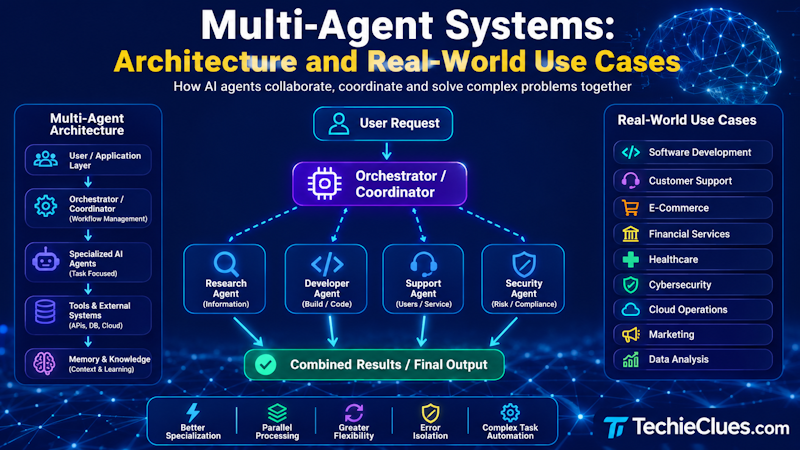
This article explains what multi-agent systems are, how multi-agent AI architecture works, their key components, benefits, challenges, and real-world use cases.
What Is a Multi-Agent System?
A multi-agent system (MAS) is an AI-based system in which multiple autonomous or semi-autonomous agents work together to accomplish a shared objective or solve a complex problem.
Each agent typically has a defined role. It can receive information, reason about a task, use tools or APIs, communicate with other agents, and produce an output.
A simple multi-agent workflow might look like this:
User Request → Orchestrator Agent → Specialized Agents → Results → Validation → Final Response
For example, imagine a user asks:
"Find the best cloud platform for our new application and create a migration plan."
A multi-agent system could assign different tasks to different agents:
- Research Agent: Researches cloud platforms.
- Architecture Agent: Evaluates technical requirements.
- Cost Agent: Compares pricing and estimated infrastructure costs.
- Security Agent: Reviews security and compliance considerations.
- Migration Agent: Creates a migration strategy.
- Review Agent: Checks the final recommendations.
The system then combines the results into a final answer.
This approach is particularly useful when a task involves multiple areas of expertise or requires several steps.
If you're new to the concept of AI agents, see this guide to What Are AI Agents? Complete Beginner's Guide.
Multi-Agent Systems vs. Single AI Agents
A single AI agent can perform many tasks, especially when it has access to tools and external services. However, complex workflows can become difficult to manage when one agent is responsible for everything.
A multi-agent system separates responsibilities.
| Feature | Single AI Agent | Multi-Agent System |
|---|---|---|
| Number of agents | One | Multiple |
| Task specialization | Limited | High |
| Complex workflows | Possible but harder to manage | Well suited |
| Parallel processing | Limited | Strong |
| Agent collaboration | Not applicable | Core capability |
| Scalability | Can become complex | Easier to divide responsibilities |
| Error isolation | More difficult | Easier to identify individual failures |
| Coordination | Simple | Requires orchestration |
The goal is not to use as many agents as possible. A well-designed system uses multiple agents only when specialization and collaboration provide a real advantage.
How Does a Multi-Agent System Work?
A typical multi-agent AI system follows a sequence of steps.
1. Receive the User Request
The system first receives a request or business objective.
For example:
"Analyze our sales data and identify opportunities to increase revenue."
The request may contain several underlying tasks.
2. Break the Problem Into Tasks
An orchestrator or planning agent analyzes the request and divides it into smaller tasks.
For example:
- Collect sales data.
- Clean and analyze the data.
- Identify sales trends.
- Analyze customer behavior.
- Identify underperforming products.
- Generate recommendations.
- Review the final analysis.
3. Assign Tasks to Specialized Agents
The system assigns each task to the most appropriate agent.
For example:
- Data Agent → data processing
- Analytics Agent → statistical analysis
- Customer Agent → customer segmentation
- Product Agent → product performance
- Recommendation Agent → business recommendations
4. Agents Perform Their Tasks
Each agent uses its own instructions, knowledge, tools, and APIs to complete its assigned work.
An agent may access:
- Databases
- REST APIs
- Enterprise applications
- Search systems
- Documents
- Cloud services
- Business intelligence platforms
- Internal knowledge bases
5. Agents Communicate
The agents exchange information as they work.
One agent's output can become another agent's input.
For example:
Data Agent → Analytics Agent → Recommendation Agent
The analytics agent does not need to retrieve and process the raw data again. It can work with the output provided by the data agent.
6. Results Are Validated
A separate validation or review agent can check whether the results are complete, consistent, and within the required rules.
This is particularly important for business-critical applications.
7. Generate the Final Result
Finally, the orchestrator combines the outputs and provides a response to the user or sends the result to another business system.
Multi-Agent System Architecture
The architecture of a multi-agent system can vary significantly depending on the application. However, most systems contain several common layers.
1. User or Application Layer
This is where the request originates.
It could be:
- A web application
- Mobile application
- Chatbot
- Internal business application
- API
- Voice assistant
- Automated workflow
The application sends the request to the agent system.
2. Orchestrator or Coordinator
The orchestrator agent manages the overall workflow.
Its responsibilities can include:
- Understanding the objective
- Creating a plan
- Selecting agents
- Assigning tasks
- Managing dependencies
- Tracking progress
- Handling failures
- Combining results
The orchestrator is often the central component of a multi-agent architecture.
3. Specialized AI Agents
Specialized agents perform individual tasks.
For example, a software development system might contain:
- Requirements Agent
- Developer Agent
- Testing Agent
- Security Agent
- Code Review Agent
- Documentation Agent
Each agent can have a different prompt, toolset, knowledge source, and objective.
4. Tools and External Systems
Agents become significantly more useful when they can interact with external tools.
Examples include:
- Databases
- APIs
- File systems
- Search engines
- Cloud platforms
- CRM systems
- Payment systems
- Monitoring tools
- Ticketing systems
Modern agent architectures can also use protocols such as Model Context Protocol (MCP) to connect AI applications with external tools and data sources.
For a detailed comparison of MCP and traditional API-based integration, see MCP vs REST API: What's the Difference?.
5. Memory and Knowledge
Agents may need access to information from previous interactions or enterprise knowledge.
A system can use:
- Short-term conversation memory
- Long-term memory
- Vector databases
- Document repositories
- Knowledge graphs
- Relational databases
- Enterprise search
Memory allows agents to maintain context and make better decisions across multi-step workflows.
6. Communication Layer
Agents need a mechanism to exchange information.
Communication can happen through:
- Direct agent-to-agent calls
- Message queues
- Events
- APIs
- Shared databases
- Workflow engines
For large-scale systems, asynchronous messaging can help agents work independently and process tasks in parallel.
7. Monitoring and Governance
Enterprise systems also need monitoring and governance.
This layer can track:
- Agent decisions
- Tool calls
- API requests
- Errors
- Execution time
- Costs
- Security events
- Human approvals
Monitoring is essential when autonomous agents interact with production systems.
Common Multi-Agent Architecture Patterns
There isn't one universal multi-agent architecture. Different applications use different coordination patterns.
Centralized Architecture
A central orchestrator controls all agents.
              User
               |
        Orchestrator
        /     |      \
   Agent A  Agent B  Agent C
        \     |      /
          Final Result
This approach is relatively easy to understand and monitor.
It works well when there is a clear workflow and one component needs to control the overall process.
Decentralized Architecture
Agents communicate directly with one another without relying entirely on a central coordinator.
Agent A <----> Agent B
   ^              ^
   |              |
   v              v
Agent C <----> Agent D
This can provide greater flexibility but introduces additional challenges around coordination, monitoring, and conflict resolution.
Hierarchical Architecture
A hierarchy of agents is used.
For example:
                    Manager Agent
                   /             \
          Research Manager     Engineering Manager
          /       \             /        \
      Agent A   Agent B      Agent C    Agent D
A manager agent can delegate work to lower-level agents.
This architecture is useful for large workflows with multiple departments or functional areas.
Sequential Workflow
Agents execute tasks one after another.
Agent A → Agent B → Agent C → Agent D
This is useful when each step depends on the output from the previous step.
Parallel Workflow
Multiple agents perform independent tasks at the same time.
              Orchestrator
             /      |      \
        Agent A  Agent B  Agent C
             \      |      /
              Aggregator
Parallel execution can reduce processing time for tasks that don't depend on one another.
Real-World Use Cases of Multi-Agent Systems
Multi-agent AI systems can be applied to many industries and business processes.
1. Software Development
Software development is one of the most promising applications.
A multi-agent development system could include:
- Product Manager Agent
- Requirements Agent
- Developer Agent
- Testing Agent
- Security Agent
- Code Review Agent
- Documentation Agent
For example, a requirements agent can convert a business request into technical requirements. A developer agent can generate implementation code, while a testing agent creates test cases.
A security agent can then analyze the implementation for common security issues.
The result is an AI-assisted software development workflow where multiple agents contribute to different stages of the development lifecycle.
2. Customer Support
Customer support platforms can use multiple agents to automate different parts of the support process.
A typical workflow could include:
Customer Request → Classification Agent → Knowledge Agent → Resolution Agent → Review Agent
The classification agent determines the type of request.
The knowledge agent searches documentation and previous solutions.
The resolution agent prepares an answer or performs an approved action.
A review agent can verify the response before it reaches the customer.
This can help businesses handle large volumes of support requests while keeping specialized workflows separate.
3. E-Commerce
E-commerce businesses can use multi-agent systems for:
- Product recommendations
- Price analysis
- Inventory management
- Customer support
- Order processing
- Fraud detection
- Marketing campaigns
For example, a shopping assistant could use one agent to understand customer requirements, another to search products, another to compare prices, and another to evaluate product reviews.
4. Financial Services
Financial organizations can use multi-agent systems for research and analysis.
Possible agents include:
- Market Research Agent
- Financial Data Agent
- Risk Analysis Agent
- Compliance Agent
- Reporting Agent
These agents can collaborate to analyze financial information and prepare reports.
Because financial applications can involve significant risk, human approval and strict governance should remain part of many production workflows.
5. Healthcare
Multi-agent systems can assist with administrative and information-processing tasks in healthcare.
Potential applications include:
- Appointment coordination
- Medical literature research
- Patient communication
- Insurance administration
- Clinical documentation
- Data analysis
Healthcare applications require strong privacy, security, regulatory controls, and human oversight. AI agents should not be treated as unrestricted replacements for qualified professionals.
6. Cybersecurity
Cybersecurity is another important area for autonomous AI agents.
Different agents can monitor:
- Network activity
- Security logs
- Vulnerabilities
- Authentication events
- Endpoint activity
- Threat intelligence
For example, a monitoring agent can detect suspicious behavior, a threat-analysis agent can investigate it, and a response agent can recommend or execute an approved remediation action.
7. Cloud Operations
Multi-agent systems can also help manage cloud environments.
A cloud operations system might use:
- Monitoring Agent
- Cost Optimization Agent
- Security Agent
- Deployment Agent
- Incident Response Agent
These agents could work together to detect infrastructure issues, analyze cloud costs, identify security risks, and recommend corrective actions.
Organizations evaluating cloud infrastructure can also review the Top Cloud Computing Service Providers to understand the major cloud platforms and their capabilities.
8. Marketing
Marketing teams can use specialized agents for:
- Keyword research
- Competitor analysis
- Content planning
- Content generation
- Social media planning
- Performance analysis
For example, a research agent can identify trending topics while a content agent creates drafts and an analytics agent evaluates campaign performance.
Human review remains important for brand voice, accuracy, originality, and strategic decisions.
9. Data Analysis
A multi-agent data analytics workflow can divide a complex analysis into several responsibilities.
For example:
Data Collection Agent → Data Cleaning Agent → Analysis Agent → Visualization Agent → Reporting Agent
This architecture can make large analytical workflows easier to organize and maintain.
Benefits of Multi-Agent AI Systems
Better Specialization
Each agent can focus on a specific task instead of trying to handle everything.
Improved Parallel Processing
Independent tasks can be performed simultaneously, potentially reducing overall execution time.
Greater Flexibility
New agents can be added without completely redesigning the entire workflow.
Better Error Isolation
If one specialized agent fails, the system can potentially retry that task or route it to another agent.
Complex Task Automation
Multi-agent systems can automate workflows that would be difficult for a single AI model to manage reliably.
Integration With Existing Systems
Agents can connect to APIs, databases, cloud services, enterprise applications, and other tools.
Challenges of Multi-Agent Systems
Despite their potential, multi-agent systems introduce several technical and operational challenges.
1. Coordination Complexity
More agents mean more communication and dependencies.
Poor coordination can result in duplicated work, conflicting decisions, or incomplete tasks.
2. Higher Cost
Every agent interaction can require model inference and tool calls. A poorly designed workflow can therefore become expensive.
Developers should minimize unnecessary agent calls and use smaller or specialized models where appropriate.
3. Security Risks
Agents with access to production systems can potentially perform actions that have real-world consequences.
Strong authentication, authorization, sandboxing, tool restrictions, and approval workflows are important.
4. Hallucinations
AI agents can still produce incorrect information.
Using multiple agents does not automatically eliminate hallucinations. In fact, an incorrect output from one agent can sometimes influence subsequent agents.
Validation and reliable data sources are therefore essential.
5. Debugging
Debugging a traditional application can already be challenging. Debugging multiple autonomous agents communicating with one another is even more complex.
Observability should capture agent decisions, tool calls, inputs, outputs, errors, and execution paths.
6. Context Management
Agents need the right information at the right time.
Providing too much context can increase cost and reduce efficiency, while providing too little context can lead to poor decisions.
Multi-Agent Systems and Agentic AI
Multi-agent systems are closely connected to the broader concept of agentic AI.
Agentic AI focuses on AI systems that can pursue goals, plan actions, use tools, adapt to changing information, and execute multi-step tasks.
A single AI agent can be agentic, but complex agentic applications may use multiple agents.
For example:
Agentic AI → Multiple Specialized Agents → Collaboration → Autonomous Workflow
This makes multi-agent systems an important architectural approach for building more sophisticated AI applications.
How to Build a Multi-Agent System
Developers planning a multi-agent application should start with the business problem rather than the number of agents.
A practical approach is:
Step 1: Define the Objective
Clearly define what the system needs to accomplish.
Step 2: Identify the Tasks
Break the workflow into logical tasks.
Step 3: Determine Agent Responsibilities
Create separate agents only where specialization provides a meaningful benefit.
Step 4: Choose the Communication Model
Decide whether agents should communicate sequentially, in parallel, hierarchically, or through an orchestrator.
Step 5: Connect Required Tools
Provide agents with access to only the tools they actually need.
Step 6: Add Memory and Knowledge
Determine what information agents need to access and how that information will be stored.
Step 7: Implement Guardrails
Add authentication, authorization, validation, rate limits, human approvals, and tool restrictions.
Step 8: Monitor the System
Track execution, errors, latency, token usage, tool calls, and agent decisions.
Step 9: Test Failure Scenarios
Test what happens when:
-
An agent returns incorrect information.
-
An API becomes unavailable.
-
An agent times out.
-
Two agents disagree.
-
A task is incomplete.
-
A tool produces unexpected data.
Step 10: Start Small
A two- or three-agent workflow is often a better starting point than building a large network of autonomous agents immediately.
Multi-Agent Systems: Best Practices
Organizations building multi-agent AI systems should consider the following best practices:
-
Use agents only when necessary. Not every workflow needs multiple agents.
-
Give each agent a clear responsibility.
-
Limit tool access using least-privilege principles.
-
Validate important outputs.
-
Keep humans involved in high-risk decisions.
-
Monitor agent interactions and tool calls.
-
Control model and API costs.
-
Use reliable sources for factual information.
-
Design for agent failures and retries.
-
Keep the architecture modular so agents can be replaced or upgraded.
The Future of Multi-Agent Systems
The future of AI is likely to involve increasingly sophisticated collaboration between models, tools, software systems, and humans.
Instead of using AI simply as a chatbot, organizations can build systems where AI agents perform specific responsibilities and coordinate to complete larger workflows.
For example, a future enterprise application might have a planning agent that coordinates research, data analysis, software development, security, deployment, and reporting agents.
However, greater autonomy also means greater responsibility. Organizations will need strong governance, security, observability, and human oversight as AI agents gain access to more business systems.
The most successful implementations are unlikely to be the ones with the largest number of agents. They will be the systems where AI agents are given clearly defined responsibilities, reliable tools, appropriate context, and measurable goals.
Conclusion
Multi-agent systems provide a practical architecture for solving complex problems by allowing multiple specialized AI agents to collaborate.
Instead of expecting one AI agent to perform every task, organizations can divide workflows among specialized agents such as researchers, developers, analysts, security agents, and reviewers. An orchestrator or communication layer can coordinate their activities and combine their results.
The technology has applications across software development, customer service, e-commerce, finance, healthcare, cybersecurity, cloud operations, marketing, and data analytics.
At the same time, multi-agent AI introduces challenges around cost, coordination, security, hallucinations, debugging, and governance. Careful architecture and strong guardrails are therefore essential.
As agentic AI continues to evolve, multi-agent systems are likely to become an important approach for building AI applications that can handle increasingly complex, multi-step workflows.


Comments (0)