

Introduction
AI applications are moving beyond simple question-and-answer interactions. Modern AI agents can search databases, access files, call business applications, execute actions, and interact with external services. As these systems become more capable, developers need reliable ways to connect AI models with the tools and data they need.
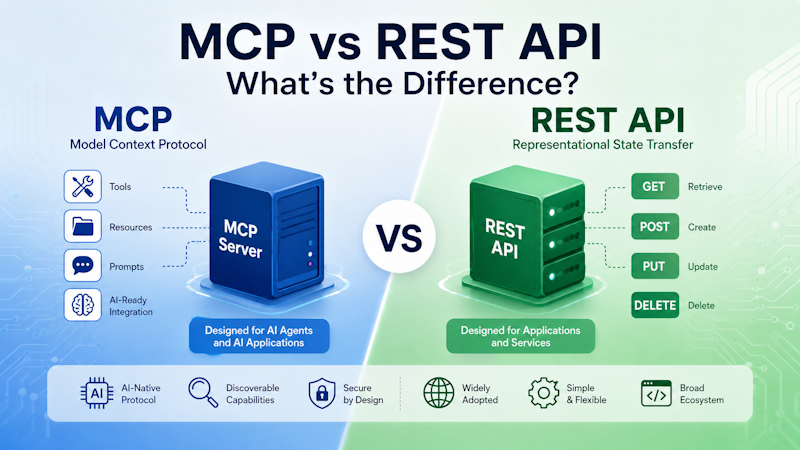
Two technologies often appear in these discussions: MCP (Model Context Protocol) and REST APIs.
At first glance, MCP and REST APIs may seem similar because both can help software communicate with external systems. However, they solve different problems.
A REST API generally exposes application functionality through HTTP endpoints. A client knows which endpoint to call, what parameters to provide, and what response to expect. HTTP methods such as GET, POST, PUT, PATCH, and DELETE define common interaction patterns.
MCP, on the other hand, is an open protocol designed specifically to connect AI applications with external tools, data, and capabilities. An MCP server can expose tools, resources, and prompts that an AI application can discover and use.
This raises an important question:
Is MCP replacing REST APIs?
The short answer is no.
MCP and REST APIs operate at different layers and can work together. In many real-world systems, an MCP server can sit between an AI application and existing REST APIs, databases, SaaS platforms, or internal services.
In this guide, we'll explain MCP vs REST API, how they differ, when to use each, and how they can work together in AI agent architectures.
What Is MCP?
MCP stands for Model Context Protocol.
It is an open standard that provides a consistent way for AI applications to connect to external systems. The protocol allows an MCP server to expose capabilities such as tools, resources, and prompts to an MCP client or host application.
Think of MCP as a standardized interface between an AI application and the outside world.
For example, an AI coding assistant could connect to MCP servers that provide access to:
- Git repositories
- Databases
- File systems
- Documentation
- Project management systems
- Cloud services
- Business applications
- Search systems
- Internal company tools
Instead of creating a completely different integration mechanism for every AI application, developers can expose capabilities through an MCP server.
How MCP Works
A simplified MCP architecture looks like this:
AI Application / AI Agent
          |
          | MCP
          v
      MCP Server
          |
    +-----+-----+------+
    |           |      |
 Database     API    Files
The AI application acts as the MCP host/client, while the MCP server provides access to specific capabilities.
For example, an MCP server might expose a tool called:
get_customer_orders
The tool could accept:
customerId
and return structured order information.
The AI agent doesn't necessarily need to know the underlying database query or internal service implementation. The MCP server handles that complexity.
The current MCP ecosystem supports tools, resources, prompts, and multiple transports. The July 2026 MCP specification also introduced changes including a more stateless protocol core, improved authorization, and other protocol capabilities.
If you're new to MCP, see our detailed guide: What Is MCP (Model Context Protocol)? Complete Guide.
What Is a REST API?
REST API stands for Representational State Transfer Application Programming Interface.
REST is an architectural style commonly used to build web APIs. REST APIs typically use HTTP and expose resources through URLs or endpoints.
For example:
GET /api/products/123
might retrieve a product.
A REST API could provide endpoints such as:
GET    /api/products
GET    /api/products/123
POST   /api/products
PUT    /api/products/123
DELETE /api/products/123
Each HTTP method communicates the intended operation. For example, GET is commonly used to retrieve information, while POST is generally used to submit data and may cause a change on the server.
A traditional application might interact with a REST API like this:
Web Application
      |
      | HTTP
      v
   REST API
      |
      v
   Database
REST APIs are widely used for communication between web applications, mobile applications, backend services, third-party platforms, and microservices.
MCP vs REST API: Key Difference
The simplest way to understand the difference is:
REST APIs are primarily designed for software-to-software communication, while MCP is designed to provide AI applications with standardized access to tools, resources, and context.
This doesn't mean REST APIs cannot be used by AI.
They absolutely can.
The important difference is how the capability is presented and discovered by the consumer.
A traditional REST client typically needs predefined knowledge about:
- API endpoints
- HTTP methods
- Request parameters
- Authentication
- Request formats
- Response formats
- Error handling
An MCP client can discover capabilities exposed by an MCP server and provide those capabilities to an AI model.
For example:
REST API

AI Application
      |
      | GET /api/weather?city=Sydney
      v
Weather API
With MCP:
AI Application
      |
      | MCP
      v
Weather MCP Server
      |
      v
Weather API
The MCP server can expose a tool such as:
get_weather
with a description and input schema that helps the AI application understand how to use it.
MCP vs REST API Comparison
| Feature | MCP | REST API |
|---|---|---|
| Primary purpose | Connect AI applications to tools and context | Expose application resources and operations |
| Designed for | AI applications and agents | Software applications and services |
| Discovery | Designed around discoverable capabilities | Usually requires API documentation |
| Tools | Native concept | Usually represented through endpoints |
| Resources | Native concept | Usually represented through resource endpoints |
| Prompts | Supported as a protocol capability | Not a native REST concept |
| AI model awareness | Designed for AI workflows | Not inherently AI-aware |
| Communication | MCP protocol and supported transports | HTTP/HTTPS |
| Authentication | MCP supports authorization mechanisms | Depends on API implementation |
| Typical consumer | AI client/host | Web, mobile, backend or other software |
| Can access databases? | Yes, through an MCP server | Yes, through backend services |
| Can access existing REST APIs? | Yes | N/A |
| Best suited for | AI agents and AI tool integration | General application integration |
The important point is that MCP isn't simply another replacement for REST. It provides a layer specifically useful for AI-driven applications.
MCP vs REST API: How the Architecture Differs
Let's look at a practical example.
Imagine you have an e-commerce application.
Your backend already exposes:
GET /api/products
GET /api/products/{id}
POST /api/orders
GET /api/orders/{id}
A traditional web application can call these REST endpoints directly.
Now suppose you want an AI agent to help customers.
A user might ask:
"Find my most recent order and tell me when it will arrive."
The AI agent needs to access customer and order information.
With a REST-only architecture, your application may need to implement logic that maps the user's request to the appropriate API calls.
With MCP, an MCP server could expose tools such as:
get_customer_orders
get_order_details
get_shipping_status
The AI application can discover these capabilities and use the appropriate tool.
The architecture could look like:
                 AI Agent
                    |
                    | MCP
                    v
               MCP Server
               /    |    \
              /     |     \
             v      v      v
          Orders  Customer Shipping
           API      API      API
The underlying APIs don't have to disappear.
The MCP server can simply provide an AI-friendly interface over those existing services.
Is MCP an API?
This is one of the most common questions about MCP.
Yes, MCP defines a protocol for communication, but it is better understood as an AI integration protocol rather than simply another conventional web API style.
A REST API exposes endpoints such as:
GET /customers/123
POST /orders
An MCP server exposes protocol capabilities such as:
tools
resources
prompts
The distinction is important.
For example, MCP tools are specifically intended to allow AI clients to ask a server to perform actions. The official MCP SDK documentation describes tools as a primary mechanism through which LLMs can interact with applications.
What Are MCP Tools?
MCP tools are executable capabilities that an AI application can invoke.
For example:
search_products
could accept:
{
  "query": "wireless headphones",
  "maxPrice": 200
}
and return matching products.
Another tool could be:
create_support_ticket
with parameters such as:
{
  "customerId": "12345",
  "subject": "Unable to log in",
  "priority": "high"
}
The MCP server defines the tool, its description, and its input schema.
This makes tools particularly useful for AI agents, because agents need to decide which capabilities to use while completing a task.
If you're exploring AI agents, see our guide: What Are AI Agents? A Complete Beginner's Guide.
What Are MCP Resources?
MCP also provides resources.
Resources allow an MCP server to expose information that an AI application can retrieve.
Examples include:
- Documentation
- Configuration information
- Files
- Database information
- Reports
- Application data
- Other reference material
The key distinction is that resources are primarily about providing information, while tools are intended for actions. The MCP SDK documentation describes resources as a way to expose data to clients without making them primarily responsible for heavy computation or side effects.
This is another area where MCP goes beyond the typical REST API abstraction.
A REST API might have:
GET /api/documentation
An MCP server can expose a resource in a way that is designed for an AI client to discover and consume.
What Are MCP Prompts?
MCP also supports prompts.
Prompts provide reusable templates that help users interact with AI systems consistently.
For example:
review_code
could provide a structured prompt for reviewing source code.
The MCP specification and SDKs treat prompts as a distinct capability from tools and resources. Prompts are generally user-selected, while tools are designed for model-driven actions.
REST APIs don't have an equivalent built-in concept.
MCP vs REST API for AI Agents
This is where the difference becomes particularly important.
An AI agent typically needs to:
- Understand a user's request
- Decide what information it needs
- Select appropriate tools
- Call external systems
- Process the results
- Potentially perform additional actions
- Return a useful response
For example:
"Check my latest order, see whether it has shipped, and create a support ticket if it is delayed."
The agent might need several capabilities:
get_customer_orders
        ↓
get_shipping_status
        ↓
create_support_ticket
MCP is designed around this type of tool-oriented interaction.
This makes MCP for AI agents particularly useful when an AI system needs to interact with many external tools and services.
For a broader look at agentic systems, see our AI Agents 2026: Complete Guide to Agentic AI.
Can MCP Replace REST APIs?
No, not in most applications.
REST APIs remain extremely useful for:
- Web applications
- Mobile applications
- Microservices
- Third-party integrations
- Public APIs
- Internal services
- Backend-to-backend communication
MCP addresses a different requirement: connecting AI applications to capabilities in a standardized way.
In fact, you can use both.
For example:
                 Web App
                    |
                    v
                REST API
                    |
                 Database


                 AI Agent
                    |
                    v
                MCP Server
                    |
                    v
                REST API
The same backend REST API can serve both your traditional applications and your AI systems.
This can be an effective architecture because you don't need to rebuild your existing backend simply because you want to add AI capabilities.
MCP vs REST API: When Should You Use MCP?
MCP is a strong option when you're building:
AI assistants
An AI assistant may need access to calendars, databases, files, email, CRM systems, or internal business applications.
AI agents
Agents often need to select and execute multiple tools dynamically.
Coding assistants
Development assistants can use MCP servers to access repositories, documentation, databases, issue trackers, and development tools.
Enterprise AI applications
Companies can expose internal capabilities through controlled MCP servers instead of building separate AI-specific integrations for every application.
AI-powered automation
If an AI system needs to retrieve information and perform actions across multiple services, MCP can provide a standardized integration layer.
When Should You Use a REST API?
REST remains the better choice when you need a general-purpose application interface.
Use REST APIs when:
- A web application needs backend services.
- A mobile application needs data.
- Microservices need to communicate.
- External developers need a conventional API.
- You are building a public developer API.
- Your clients already understand HTTP and REST.
- You need straightforward CRUD operations.
- Your API isn't specifically intended for AI applications.
For example, a banking application might expose:
GET /accounts
GET /accounts/{id}
GET /transactions
POST /payments
There is no need to introduce MCP simply because the application has an API.
MCP and REST API Can Work Together
One of the biggest misconceptions is that developers need to choose between MCP and REST.
In reality, they can complement each other.
Consider a company with these existing services:
Customer REST API
Order REST API
Payment REST API
Inventory REST API
Support REST API
Instead of modifying every service for AI, you can create an MCP server:
                    AI Agent
                       |
                       | MCP
                       v
                  MCP Server
                 /    |     \
                /     |      \
               v      v       v
           Customer  Order   Support
              API      API      API
The MCP server becomes an AI integration layer.
This approach allows existing REST APIs to continue serving traditional applications while MCP provides an AI-friendly interface.
MCP vs REST API: Security Considerations
Security is important with both approaches.
A REST API may use:
- API keys
- OAuth 2.0
- JWT tokens
- Mutual TLS
- Network controls
- Rate limiting
- Role-based access control
MCP implementations also need strong authentication and authorization controls, particularly when AI agents can invoke tools that perform real-world actions.
The current MCP specification continues to evolve its authorization and security model. The July 2026 specification included authorization hardening and additional security-related changes.
For an AI agent, security becomes especially important because the model may be able to invoke tools based on user instructions.
For example, a tool such as:
delete_customer
should not be exposed without appropriate authorization and safeguards.
A good MCP implementation should consider:
- Authentication
- Authorization
- Least-privilege access
- Input validation
- Tool permissions
- Sensitive data handling
- Audit logging
- Rate limiting
- Human approval for high-risk operations
MCP vs REST API Performance
Performance depends heavily on the implementation.
REST APIs are mature and widely optimized for high-throughput web and service communication.
MCP introduces additional protocol and integration layers when an AI application interacts with an MCP server. However, the goal isn't necessarily to make every API request faster.
The value of MCP is primarily standardized AI integration and capability discovery.
For example:
Traditional application
        ↓
REST API
        ↓
Fast backend operation
versus:
AI Agent
    ↓
MCP
    ↓
Tool selection
    ↓
MCP Server
    ↓
Backend API
The second architecture may involve additional steps, but it enables an AI system to interact with capabilities in a standardized manner.
MCP vs REST API: Developer Experience
REST APIs are familiar to most developers.
A developer can read API documentation and make an HTTP request:
GET /api/products/123
MCP adds concepts specifically relevant to AI development:
- MCP hosts
- MCP clients
- MCP servers
- Tools
- Resources
- Prompts
- Capability discovery
- Protocol versions
- Transports
For developers building AI agents, these concepts can significantly simplify integrations.
For developers building conventional web applications, REST will often remain simpler.
MCP vs REST API: A Simple Real-World Example
Suppose you create an AI shopping assistant.
The user says:
"Find a laptop under $1,500 with at least 16 GB RAM and tell me which one has the best rating."
A traditional application could call REST APIs such as:
GET /products?category=laptop
GET /products/{id}/reviews
The application developer writes the logic that determines which endpoints to call.
With MCP, an MCP server might expose:
search_products
get_product_details
get_product_reviews
The AI agent can use these tools as part of its task.
The MCP architecture might look like:
User
  |
  v
AI Agent
  |
  | MCP
  v
Shopping MCP Server
  |
  +---- search_products
  |
  +---- get_product_details
  |
  +---- get_product_reviews
             |
             v
       Existing REST APIs
This is one of the main reasons MCP for AI agents is becoming an important architecture pattern.
MCP vs REST API: Advantages and Disadvantages
Advantages of MCP
1. Designed for AI applications
MCP was designed specifically around the needs of AI applications and agents.
2. Standardized tool integration
Instead of creating a custom integration pattern for every AI application, MCP provides a common protocol.
3. Capability discovery
AI applications can discover available tools and other capabilities from an MCP server.
4. Supports tools, resources, and prompts
MCP provides more AI-oriented primitives than a conventional REST API.
5. Works with existing systems
MCP servers can act as an integration layer over databases, APIs, files, and other services.
Disadvantages of MCP
1. Additional architecture
If you already have a simple REST API and don't need AI integration, adding MCP may create unnecessary complexity.
2. New concepts
Developers need to understand MCP clients, servers, tools, resources, prompts, transports, and authorization.
3. Security requires careful design
Giving AI systems access to tools can introduce additional security considerations.
4. Not a replacement for general APIs
MCP isn't intended to replace every REST API in an application's architecture.
Advantages of REST APIs
REST APIs have several major strengths:
- Mature ecosystem
- Broad language support
- Simple HTTP-based communication
- Easy integration with web and mobile applications
- Well-understood authentication mechanisms
- Extensive tooling
- Excellent support across cloud platforms
- Suitable for public and internal APIs
REST is still an excellent choice for general-purpose application development.
MCP vs REST API: Which One Should You Choose?
The answer depends on what you're building.
| Your Requirement | Recommended Approach |
|---|---|
| Web application backend | REST API |
| Mobile application backend | REST API |
| Microservice communication | REST API or another service protocol |
| Public developer API | REST API |
| AI assistant integration | MCP |
| AI agent tool integration | MCP |
| Give an AI access to existing services | MCP + existing APIs |
| AI access to databases | MCP server |
| AI coding assistant integration | MCP |
| Existing REST API with new AI functionality | Keep REST + add MCP layer |
In many modern architectures, the best answer isn't MCP or REST.
It is:
MCP + REST API.
MCP vs REST API: The Future of AI Integration
AI applications are becoming more capable, and the way they interact with external systems is changing.
Traditional applications generally follow a predictable flow:
Application
    ↓
API
    ↓
Service
    ↓
Database
AI agents introduce a more dynamic workflow:
User
  ↓
AI Agent
  ↓
Understand task
  ↓
Select tool
  ↓
Call external service
  ↓
Analyze result
  ↓
Select next action
This is where protocols such as MCP can become valuable.
The MCP ecosystem is also expanding rapidly, with official SDKs and an MCP server registry providing infrastructure for discovering and building MCP integrations.
However, this doesn't make REST obsolete.
REST will continue to provide the underlying application and service infrastructure in many systems. MCP can provide a standardized interface that allows AI applications and agents to interact with that infrastructure.
Final Thoughts
The MCP vs REST API comparison isn't really about choosing one technology over the other.
REST APIs are designed for broad software integration and remain one of the most important ways applications communicate with backend services.
MCP addresses a newer challenge: how AI applications and AI agents can discover and interact with external tools, resources, and services in a standardized way.
A useful way to remember the difference is:
REST API
"Here are my endpoints. Call them according to the API contract."

MCP
"Here are the capabilities available to the AI application,
including tools, resources, and prompts."
For traditional applications, REST APIs will often remain the right choice.
For AI assistants and agentic applications, MCP can provide a powerful integration layer.
And for many modern systems, the most practical architecture is not MCP versus REST API, but MCP working together with REST APIs.
As AI agents become more capable, understanding both technologies will become increasingly important for developers building the next generation of AI-powered applications.


Comments (0)