

Introduction
Artificial Intelligence (AI) is no longer just a futuristic concept—it has become an essential part of modern software development. From writing code and detecting bugs to automating testing and improving DevOps workflows, AI is helping developers build high-quality applications faster than ever before.
In 2026, AI has evolved beyond simple code suggestions. Today's AI-powered development tools understand project context, generate documentation, review pull requests, create unit tests, optimize performance, and even assist with software architecture decisions.
Whether you're a beginner learning programming or an experienced software engineer managing enterprise applications, AI is changing the way software is designed, built, tested, and maintained.
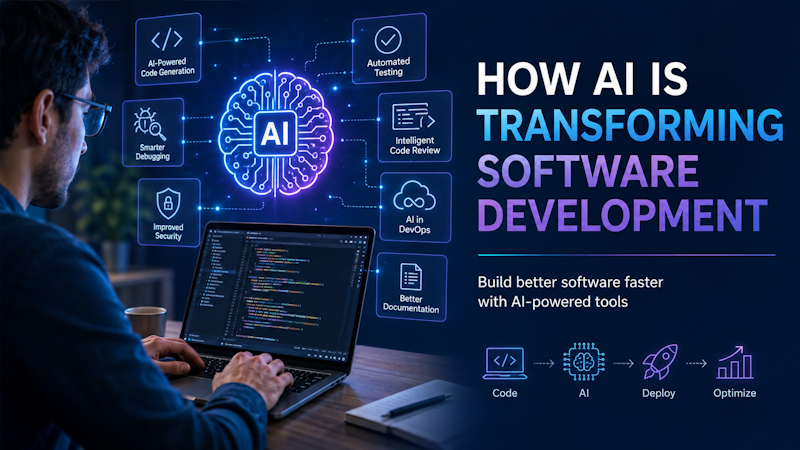
AI-powered software development is evolving alongside broader advancements in artificial intelligence and cloud technologies. To stay ahead, explore our guide on Top Generative AI Trends for 2026 to understand emerging innovations, and compare today's leading AI assistants in ChatGPT vs Gemini vs Claude: Complete Comparison (2026). These resources provide additional insights into the technologies shaping the future of software engineering.
In this article, we'll explore how AI is transforming software development and why every developer should embrace AI as a productivity partner rather than viewing it as a replacement.
The Evolution of AI in Software Development
A few years ago, AI coding assistants were mainly used for auto-completing functions.
Today, AI can:
- Understand business requirements
- Generate production-ready code
- Refactor existing applications
- Detect security vulnerabilities
- Explain complex code
- Generate documentation
- Create unit and integration tests
- Assist with DevOps pipelines
Modern AI models understand multiple programming languages and can work across entire projects instead of isolated files.
1. AI-Powered Code Generation
One of the biggest transformations is AI-assisted coding.
Developers no longer write every line manually. Instead, AI helps generate:
- APIs
- CRUD operations
- Database queries
- UI components
- Authentication logic
- Error handling
- Validation code
For example, a developer can simply write:
"Create an ASP.NET Core Web API with JWT authentication."
AI can generate the initial project structure within seconds.
This significantly reduces repetitive coding and allows developers to focus on solving business problems.
2. Faster Bug Detection and Debugging
Debugging has traditionally been one of the most time-consuming tasks in software development.
AI tools now help developers by:
- Explaining error messages
- Identifying root causes
- Suggesting fixes
- Detecting logic issues
- Finding null reference exceptions
- Spotting performance bottlenecks
Instead of spending hours searching Stack Overflow or documentation, developers can resolve issues much faster with AI-powered suggestions.
3. Smarter Code Reviews
Code reviews improve software quality but often consume significant developer time.
AI can automatically review code by checking for:
- Code smells
- Security vulnerabilities
- Duplicate logic
- Naming inconsistencies
- Best practice violations
- Performance improvements
This allows senior developers to focus on architecture and business logic instead of reviewing basic coding mistakes.
4. Automated Unit Test Generation
Writing unit tests is important but often neglected due to deadlines.
AI can generate:
- Unit tests
- Integration tests
- Mock objects
- Test cases
- Edge case scenarios
Developers can achieve better test coverage with significantly less effort.
Benefits include:
- Higher reliability
- Faster releases
- Better maintainability
- Reduced production bugs
5. AI in DevOps and CI/CD
Modern DevOps pipelines increasingly use AI to automate repetitive tasks.
AI assists with:
- Build optimization
- Deployment recommendations
- Infrastructure monitoring
- Log analysis
- Failure prediction
- Incident detection
AI can analyze thousands of deployment logs and identify patterns that humans might overlook.
This helps teams reduce downtime and improve system reliability.
6. Better Documentation Generation
Documentation is often outdated because developers rarely have time to maintain it.
AI can automatically generate:
- API documentation
- README files
- Architecture summaries
- Function descriptions
- Inline code comments
- Release notes
Accurate documentation improves collaboration and accelerates onboarding for new developers.
7. AI-Assisted Software Architecture
AI is becoming increasingly useful during the planning stage of software development.
It can recommend:
- Project structure
- Design patterns
- Database schema
- Microservices boundaries
- API design
- Technology stack
While architects still make the final decisions, AI provides valuable suggestions based on industry best practices.
8. Improved Security
Security is a critical concern in modern applications.
AI tools can identify:
- SQL Injection vulnerabilities
- Cross-Site Scripting (XSS)
- Hardcoded credentials
- Weak authentication
- Insecure APIs
- Dependency vulnerabilities
Early detection helps developers fix issues before applications reach production.
9. Natural Language Programming
One of the most exciting advancements is Natural Language Programming.
Instead of writing detailed code manually, developers describe requirements in plain English.
Example:
"Build a responsive login page using React and Tailwind CSS with email validation."
AI generates the required code almost instantly.
This makes software development faster and lowers the learning curve for beginners.
10. Learning and Upskilling
AI has become a personal programming mentor.
Developers use AI to:
- Learn new frameworks
- Understand algorithms
- Explain legacy code
- Generate coding examples
- Explore best practices
Instead of reading lengthy documentation, developers receive interactive explanations tailored to their needs.
Benefits of AI in Software Development
Organizations adopting AI experience several advantages:
- Faster development cycles
- Increased developer productivity
- Reduced repetitive work
- Better code quality
- Lower maintenance costs
- Improved software security
- Faster onboarding
- Higher testing coverage
- More consistent documentation
- Quicker release cycles
Challenges of Using AI
Despite its benefits, AI is not perfect.
Developers should be aware of several limitations.
AI Can Produce Incorrect Code
Generated code should always be reviewed before deployment.
Security Risks
AI-generated code may occasionally introduce security vulnerabilities if not validated.
Lack of Business Context
AI doesn't fully understand unique business requirements without sufficient context.
Overdependence
Developers should avoid relying entirely on AI, as strong programming fundamentals remain essential.
Popular AI Tools for Developers in 2026
Several AI-powered tools have become part of daily development workflows.
- GitHub Copilot
- ChatGPT
- Claude
- Gemini
- Cursor AI
- Windsurf
- Amazon Q Developer
- Tabnine
- Continue.dev
- Sourcegraph Cody
Each tool offers unique strengths, from intelligent code completion to debugging, documentation, and enterprise-scale code search.
Best Practices for Using AI in Development
To get the most value from AI:
- Review generated code carefully.
- Validate AI suggestions with official documentation.
- Never expose sensitive credentials or confidential source code to public AI services.
- Write clear prompts that include requirements and constraints.
- Use AI to automate repetitive work, not critical architectural decisions.
- Keep your programming skills sharp alongside AI-assisted workflows.
Will AI Replace Software Developers?
The short answer is No.
AI is transforming software development by enhancing productivity rather than replacing developers.
Successful software projects still require:
- Business understanding
- Creative problem-solving
- System architecture
- Stakeholder communication
- User experience design
- Security planning
- Technical decision-making
AI handles repetitive tasks, while developers provide judgment, creativity, and domain expertise.
The future belongs to developers who know how to collaborate effectively with AI.
Final Thoughts
AI has fundamentally changed software development in 2026. From intelligent code generation and automated testing to smarter debugging and AI-assisted DevOps, developers now have access to tools that dramatically improve productivity and software quality.
However, AI is most effective when paired with human expertise. The best developers use AI to accelerate routine work while focusing their time on architecture, innovation, and solving real business challenges.
As AI capabilities continue to evolve, learning how to integrate these tools into your daily workflow will become an essential skill for every software professional.
Frequently Asked Questions (FAQ)
Is AI replacing software developers?
No. AI automates repetitive tasks and boosts productivity, but developers remain essential for architecture, problem-solving, and business decision-making.
What are the benefits of AI in software development?
AI speeds up coding, improves code quality, automates testing, assists with debugging, strengthens security checks, and streamlines documentation.
Which AI tools are popular among developers in 2026?
Popular tools include GitHub Copilot, ChatGPT, Claude, Gemini, Cursor AI, Windsurf, Amazon Q Developer, Tabnine, Continue.dev, and Sourcegraph Cody.
Can beginners use AI for programming?
Yes. AI can explain concepts, generate sample code, answer programming questions, and help beginners learn faster. However, understanding programming fundamentals is still important.
What are the risks of AI-generated code?
Potential risks include incorrect logic, security vulnerabilities, outdated practices, and lack of business context. Developers should always review and test AI-generated code.


Comments (0)