

Introduction
Generative AI has evolved from an experimental technology into a business-critical capability. What began with AI-powered chatbots and content generation tools has rapidly expanded into intelligent agents, multimodal systems, autonomous workflows, and AI-driven software engineering.
As we move through 2026, organizations across industries are investing heavily in AI technologies that improve productivity, automate decision-making, and create new opportunities for innovation. From startups to global enterprises, the race to adopt advanced AI solutions is accelerating.
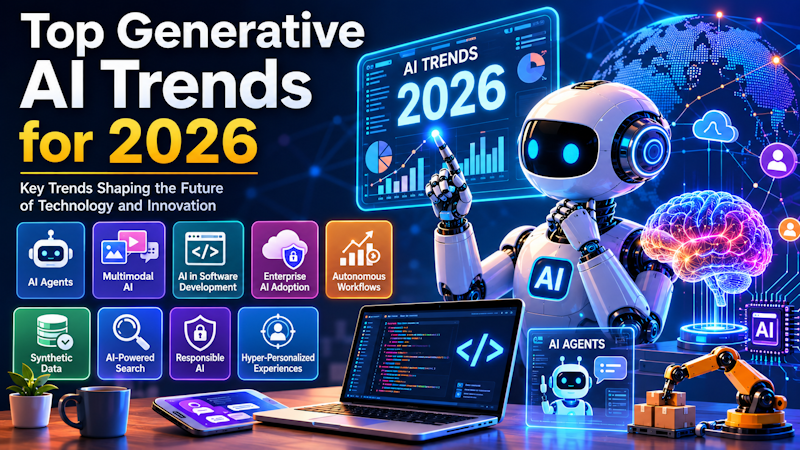
In this article, we'll explore the most important Generative AI trends shaping 2026 and how they are transforming the future of work, software development, and digital experiences.
1. Agentic AI Becomes Mainstream
One of the biggest trends in 2026 is the rise of Agentic AI.
Unlike traditional AI assistants that respond to prompts, AI agents can plan tasks, make decisions, execute actions, and interact with multiple systems autonomously.
Examples include:
- Customer support agents handling entire service requests
- Sales agents generating leads and scheduling meetings
- Software agents creating, testing, and deploying code
- Research agents gathering and analyzing information
Businesses are increasingly deploying AI agents to automate complex workflows that previously required human intervention.
Why It Matters
Organizations can significantly reduce operational costs while improving efficiency and response times.
2. Multimodal AI Dominates Enterprise Applications
Generative AI is no longer limited to text.
Modern AI models can understand and generate:
- Text
- Images
- Audio
- Video
- Documents
- Structured data
Multimodal AI enables organizations to build richer applications capable of processing information from multiple sources simultaneously.
Real-World Applications
- Intelligent document processing
- AI-powered video generation
- Visual customer support systems
- Medical image analysis
- Automated content creation platforms
In 2026, multimodal AI is becoming the standard rather than the exception.
3. AI Agents Transform Software Development
Software development is undergoing a major transformation.
AI coding assistants have evolved from code completion tools into collaborative development partners capable of:
- Writing production-ready code
- Refactoring applications
- Creating test cases
- Generating documentation
- Performing code reviews
- Detecting security vulnerabilities
Developers are increasingly focusing on architecture, design, and business logic while AI handles repetitive coding tasks.
Benefits
- Faster development cycles
- Reduced technical debt
- Improved code quality
- Increased developer productivity
4. Enterprise AI Adoption Accelerates
Many organizations spent the last few years experimenting with AI. In 2026, the focus has shifted to large-scale deployment.
Key areas of enterprise adoption include:
- Customer service automation
- Knowledge management
- Financial analysis
- Human resources
- Compliance monitoring
- Internal productivity tools
Companies are now integrating AI directly into their core business processes rather than treating it as a standalone innovation initiative.
5. Smaller Specialized AI Models Gain Popularity
While large foundation models continue to improve, organizations are increasingly adopting smaller, specialized models designed for specific tasks.
Benefits include:
- Lower operating costs
- Faster inference
- Better privacy controls
- Easier deployment
- Industry-specific optimization
Examples include models focused on:
- Healthcare
- Finance
- Legal services
- Manufacturing
- Customer support
This trend is helping businesses achieve better ROI from AI investments.
6. Synthetic Data Becomes a Strategic Asset
Data remains the foundation of AI success.
However, privacy concerns and regulatory requirements often limit access to real-world data.
Synthetic data generation is emerging as a solution by creating realistic, AI-generated datasets that mimic real information without exposing sensitive details.
Key Use Cases
- Model training
- Software testing
- Fraud detection
- Healthcare research
- Autonomous systems
Organizations are increasingly using synthetic data to improve AI performance while maintaining compliance.
7. AI-Powered Search Replaces Traditional Search Experiences
Search is evolving rapidly.
Instead of presenting a list of links, AI-powered search engines provide:
- Direct answers
- Personalized recommendations
- Context-aware insights
- Conversational interactions
Businesses are adapting their SEO strategies to ensure content remains discoverable in AI-driven search environments.
Impact on Digital Marketing
Content quality, expertise, and authority are becoming more important than traditional keyword optimization alone.
8. Responsible AI and Governance Become Business Priorities
As AI adoption grows, organizations are placing greater emphasis on responsible AI practices.
Key focus areas include:
- Transparency
- Bias mitigation
- Data privacy
- Regulatory compliance
- Security controls
- Model monitoring
Companies that establish strong AI governance frameworks will gain a competitive advantage while reducing operational and legal risks.
9. Hyper-Personalized Customer Experiences
Generative AI is enabling businesses to deliver highly personalized experiences at scale.
Applications include:
- Personalized marketing campaigns
- Product recommendations
- Dynamic website content
- Customer support interactions
- Learning and training platforms
AI systems can now understand user preferences and behavior patterns more accurately than ever before.
10. Autonomous Business Workflows Expand
Businesses are moving beyond simple automation toward fully autonomous workflows.
Examples include:
- Invoice processing
- Procurement management
- Customer onboarding
- Financial reporting
- Supply chain optimization
These systems combine AI agents, workflow automation, and enterprise integrations to complete end-to-end business processes with minimal human involvement.
What Businesses Should Do in 2026
To remain competitive, organizations should:
- Identify high-value AI use cases.
- Invest in AI governance and security.
- Explore AI agent implementations.
- Adopt multimodal AI capabilities.
- Upskill employees on AI tools.
- Evaluate opportunities for workflow automation.
- Monitor emerging AI regulations.
Companies that strategically embrace Generative AI will be better positioned to improve efficiency, reduce costs, and create innovative customer experiences.
Final Thoughts
Generative AI in 2026 is moving far beyond chatbots and content generation. The rise of AI agents, multimodal intelligence, autonomous workflows, and enterprise-scale AI deployments is reshaping how businesses operate and compete.
Organizations that successfully integrate these technologies into their products, services, and operations will gain significant advantages in productivity, innovation, and customer engagement. As AI capabilities continue to advance, staying informed about emerging trends will be essential for technology leaders, developers, and business decision-makers alike.
The future of Generative AI is not just about creating content—it's about creating intelligent systems that can think, act, collaborate, and deliver measurable business value.


Comments (0)